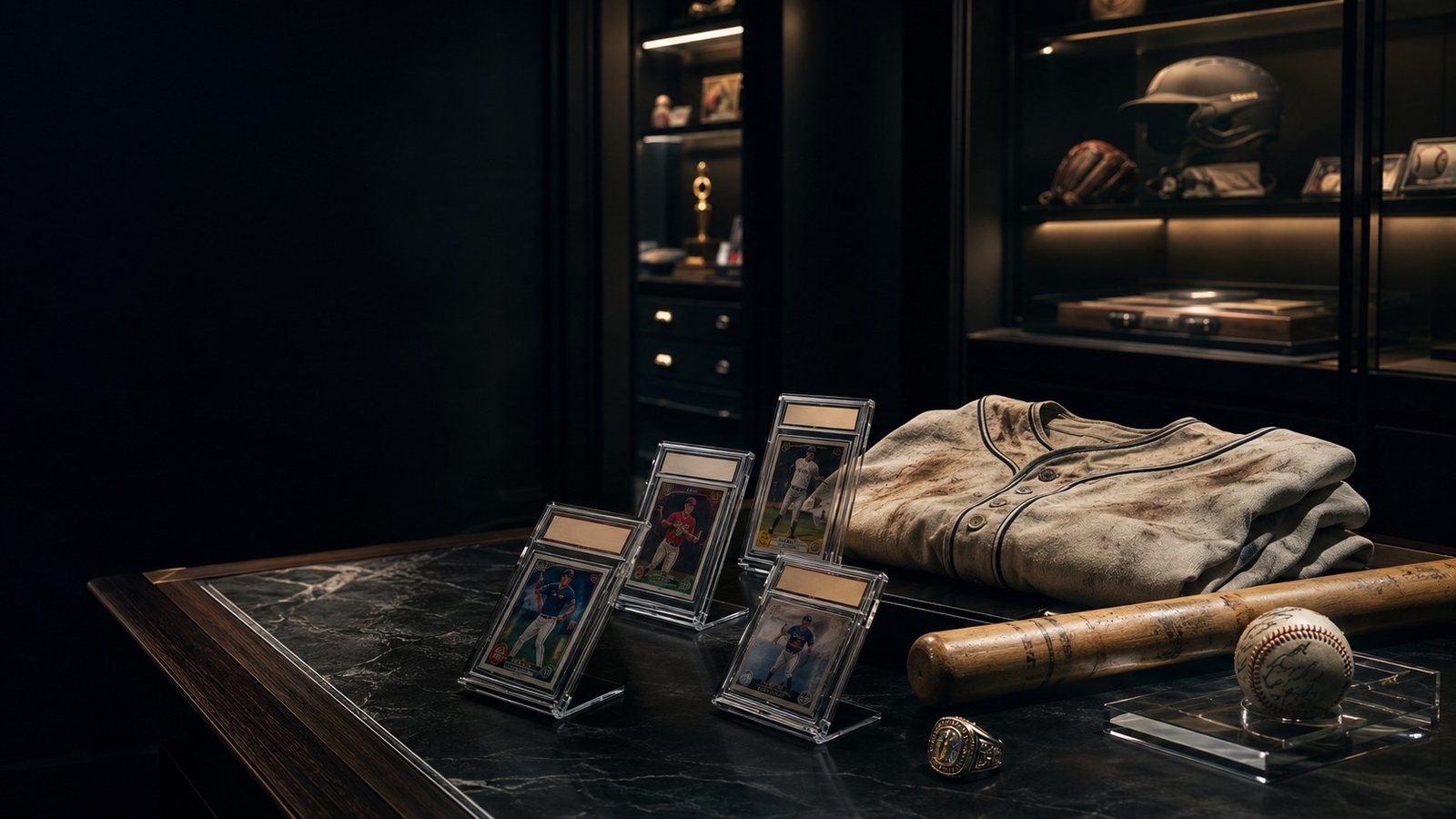
Memorabilia & Collectibles Financing

Raise Capital Against Your
Memorabilia & Sports Collectibles

Turn a graded card, a game-worn jersey, a signed piece, or a full collection into working capital without ever putting it up for sale. LQD arranges private capital secured by qualifying sports and entertainment memorabilia, priced on authenticity, provenance, condition, grading, and demand. Underwriting is AI-assisted and asset-based, with no credit check and no income verification, and your piece stays in your name so you keep the upside. Eligibility and terms are not guaranteed.

Memorabilia as Collateral

Borrow Against the Pieces You Would Rather Keep

Serious memorabilia is wealth that sits in a display case or a safe. When a card, a jersey, a ring, or a collection carries real secondary-market value, it can quietly back the capital you need instead of being sold. LQD arranges private, asset-backed capital against qualifying sports and entertainment pieces, from a single standout item to a deep multi-item archive, so you can raise liquidity and still own the thing that mattered enough to acquire in the first place.

Eligibility is driven by the piece, not by you. Authenticity, ownership, provenance, condition, documentation, rarity, grading, demand, legal transferability, and LQD's valuation decide what a submission can support. A famous name, a big signature, a high grade, or an authentication label is helpful, but none of them alone proves value or guarantees eligibility. Because underwriting is asset-based, there is no credit check and no income verification.

One habit is worth building early: keep the numbers separate. What a piece meant to you, what you paid for it, what it would cost to replace on an insurance schedule, what an auction house estimates, what a dealer is asking, and where the grading population sits are all different from collateral value. Collateral value is our read on what the piece could realistically achieve in today's market, weighed against condition, paperwork, transferability, and buyer demand.

Everything moves discreetly and quickly. With a complete submission, our AI-assisted underwriting can surface indicative terms within hours, and once an arrangement is approved and closed, funding is typically completed within 24 to 72 hours. Send whatever documentation you have and we will work from there.

At a Glance

Asset Type
Sports & Entertainment Memorabilia, Trading Cards, Game-Worn Items
Examples
Graded cards, game-worn jerseys and gear, championship rings and trophies, autographs, entertainment pieces
Capital Range
$10,000 to $10,000,000
Indicative Terms
Often within hours of a complete submission
Funding
Typically 24 to 72 hours after approval
Underwriting
AI-assisted and asset-based, no credit check

What Helps a Submission

Nothing on this list is required to open a confidential review. When you happen to have these records, they sharpen the valuation and speed the process along:

  • Third-party grading slabs and authentication certificates, if you have them
  • Chain-of-custody notes, team or league records, and manufacturer paperwork
  • Photo-matching reports for game-worn or event-worn claims
  • Purchase receipts, dealer invoices, and past auction results
  • Provenance and ownership records, plus estate paperwork for inherited pieces
  • Condition reports and any restoration or alteration history
  • Proof of clear ownership and any licensing or transfer restrictions you know of

Grades and certificates support a review; they do not by themselves set collateral value or guarantee eligibility.

By Category

Cards, Game-Worn Gear, Autographs, or an Entire Collection

A wide range of pieces can be considered. Across all of them, ownership, clear title, legal transferability, LQD's valuation, and underwriting apply, and eligibility and terms are not guaranteed.

Trading Cards

Sports cards, Pokemon, Magic: The Gathering, and other cards of real value can be reviewed on authenticity, grade, scarcity within the issue, and how active the market is. A slab helps, but the grade alone does not fix the number, and demand swings by player, character, set, and era.

Game-Worn Jerseys and Gear

Jerseys, bats, balls, helmets, and equipment can be reviewed when the game-worn claim is backed by a documented chain of custody, team or league records, or photo matching. A tag on its own is not enough, and the quality of the provenance usually carries the most weight.

Autographs and Signed Documents

Signed photos, documents, and equipment can be reviewed where the signature is credibly genuine and buyers are there. Authentication and witnessed-signing records help, though a signature or certificate by itself does not prove authenticity or set value.

Championship Rings, Trophies, and Awards

Rings, trophies, and awards can be reviewed when documentation confirms the recipient, team, and event and there is recognized collector demand. Ownership, clear title, and any league transfer restrictions are all part of the picture.

Sealed Boxes and Unopened Product

Sealed boxes and unopened material can be reviewed on authenticity, condition, product, and market support. Because sealed product is a target for resealing, confirming integrity is central, and not every sealed item carries meaningful value.

Historic Sports Artifacts

Early cards, tickets, programs, and documents of genuine significance can be reviewed when authenticity, provenance, and demand hold up. Age adds interest, but on its own it does not establish collateral value.

Film, Television, and Music Memorabilia

Entertainment pieces, including props, wardrobe, signed items, and historic material, can be reviewed where authenticity and provenance are supported. Owning the object does not include any image, publicity, licensing, or reproduction rights.

Athlete, Team, or Studio Collections

A broader archive can be reviewed as a single pledge, whether it centers on one athlete, team, or field or ranges across several. Each piece is still judged on its own, while the collection is weighed for depth and demand.

Eligible Memorabilia

What Tends to Qualify

Pieces are considered on authenticity, ownership, provenance, condition, documentation, rarity, grading, transferability, demand, LQD's valuation, and underwriting. The list is illustrative, not exhaustive, and everything is reviewed individually.

Graded and Raw Trading Cards

Cards across sports, Pokemon, Magic: The Gathering, and other lines can be reviewed on authenticity, grade, and scarcity within the issue. Low-population, high-grade examples of widely collected names tend to draw the deepest demand, though the grade alone does not set the number and each card is read on its own market.

Game-Worn Equipment & Jerseys

Jerseys, bats, balls, helmets, and gear can be reviewed when a documented chain of custody stands behind them. Team or league records, a certificate, or photo matching turn a claim into something documented, and provenance quality usually matters most of all.

Championship Rings & Trophies

Rings, trophies, and awards can be reviewed when documentation confirms the recipient, team, and event. Ownership, clear title, and any transfer restrictions are part of the read, and recognized collector demand supports the value.

Autographed Pieces

Signed photos, documents, and equipment across major sports can be reviewed where the signature is credibly genuine and demand is recognized. Authentication and witnessed-signing records strengthen a submission, though a signature or certificate alone does not prove authenticity or value.

Vintage & Historic Artifacts

Early cards, tickets, programs, and documents of real significance can be reviewed in authenticated, well-kept condition with documented provenance and recognized demand. Age alone does not establish value.

Entertainment & Full Collections

Film, television, and music pieces, along with athlete, team, or field collections, can be reviewed where authenticity and provenance are supported. A collection is weighed as one pledge while each piece is judged individually, and owning the object does not include licensing or image rights.

Valuation

What Actually Sets Memorabilia Collateral Value

Pricing for capital purposes reads many signals at once rather than leaning on a single grade, label, or headline sale. Nothing below is a fixed or guaranteed figure.

Authenticity & Attribution
Whether a piece is credibly what it claims to be, and credibly tied to the athlete, artist, team, or event, is where every review starts. A famous association asserted without evidence does not carry the analysis.
Game-Worn or Event-Worn Evidence
For used items, a documented chain of custody, team or league records, and photo matching support the claim. Photo matching strengthens provenance but does not, on its own, guarantee value.
Provenance & Ownership Trail
A documented line of ownership supports both authenticity and title. Notable prior owners can add interest, while gaps may call for more paperwork.
Signature & Authentication
Signatures and inscriptions are read on the evidence. Third-party authentication supports a review, but a signature or certificate alone does not establish authenticity.
Grading, Population & Serials
Grades, population reports, print runs, holograms, and serial numbers help place a piece. A strong grade does not automatically guarantee value, and population data does not guarantee that buyers are present.
Rarity, Era & Significance
Scarcity, period, and ties to a championship or milestone can lift demand, but rarity or significance by itself does not set collateral value.
Condition & Restoration
Original condition, completeness, and any restoration, trimming, or alteration are weighed carefully, since they can push value either way and undisclosed work is a particular concern.
Comparable Results
Recent public and private sales, adjusted for condition, grade, and market cycle, inform the read far more than any single record price.
Collector & Dealer Demand
How deep the collector base runs and how strong dealer support is shape a realistic figure in the current market.
Liquidity
How easily a piece could realistically be sold has a direct effect on value. Shallow or unpredictable demand counts against it, regardless of the grade or the name attached.
Legal Transferability & Rights
Lawful ownership and the right to pledge must be clear. Owning the object does not include image, publicity, trademark, copyright, licensing, or reproduction rights.
LQD's Valuation
Our valuation ties these threads together. It is not a guaranteed appraisal, and it is not the same as an insurance figure, an auction estimate, grading-company data, or the price once paid.

Keep the figures apart. Sentimental worth, original cost, an insurance replacement figure, an auction presale estimate, a dealer asking price, grading-population data, and resale value can all differ, and none of them is automatically the collateral value. Insurance value usually reflects replacement cost and typically runs higher. A record set by one item does not lock in a value for another. Collateral value reflects LQD's read of what a piece could realistically support in today's secondary market, subject to underwriting.

Authentication & Rights

How We Read Authenticity and Ownership

Authentication and grading support a review; they do not decide it. A strong number does not automatically guarantee value, population reports do not guarantee that buyers are there, and a certificate or label alone may not fix a figure. A signature does not prove authenticity on its own, and a game-worn claim needs evidence behind it.

Depending on the piece, useful evidence includes third-party authentication and grading records, holograms and serial numbers, manufacturer, team, or league paperwork, photo matching, letters of provenance, purchase and auction records, estate documents, chain-of-custody notes, and expert opinion. Photo matching can support provenance without guaranteeing eligibility, and an auction house accepting a piece does not guarantee a capital offer. Lawful ownership and the right to transfer must be established.

Owning a physical piece is not the same as owning the rights attached to it. Holding a jersey, a photo, a prop, or a signed item does not convey any image, publicity, trademark, copyright, licensing, or reproduction rights in the athlete, team, artist, film, or brand it depicts. Those rights sit separately and are never part of a collateral arrangement.

LQD claims no affiliation with, endorsement by, or authority on behalf of any athlete, team, league, grading company, authentication service, auction house, museum, studio, or record label. Names appear only for accurate description, and LQD does not authenticate memorabilia itself.

What Reinforces a Review

Verifiable Authenticity
Proof that goes beyond a name, signature, or label on its own.
Recorded Provenance
A custody and ownership trail supported by paperwork.
Evidenced Use Claims
Club or league documentation and photo matching where applicable.
Transparent Condition
Complete disclosure of condition and any restoration work.
Clean Title
Legal ownership and the authority to pledge the piece.

Each of these supports a review; none of them alone guarantees authenticity, value, or eligibility.

Documentation

What to Send for a Memorabilia Review

You do not need a full file to start a confidential review, but records help with authenticity, ownership, provenance, condition, transferability, valuation, and underwriting. The more you can share, the faster we can move, and anything you lack does not automatically end the conversation.

Records and images that help include:

  • Clear overall photos, plus front, back, side, interior, and detail shots where relevant
  • Signature, inscription, label, tag, patch, stamp, hologram, and serial-number images
  • Dimensions and weight where relevant, and the athlete, team, artist, film, event, or era
  • Game, season, championship, production, or event association
  • Purchase receipts, dealer invoices, and past auction results
  • Authentication certificates, grading records, and photo-matching reports
  • Team, league, or manufacturer paperwork
  • Provenance, ownership, estate records, and chain-of-custody notes
  • Restoration or alteration history and condition reports
  • Insurance schedules, current storage location, and any existing liens
  • Any ownership, licensing, or transfer restrictions you know of

The point is not to gather everything before reaching out. Share what you have, and our AI-assisted underwriting can turn a complete submission into indicative terms within hours.

Custody, Handling & Insurance

A pledged piece or collection is held in insured, secure storage suited to the material for the term. On receipt we prepare a documented intake with condition photos and a written inventory, and everything is returned in the condition received once the balance is repaid.

Where transport is needed, LQD arranges specialist handling, appropriate packing, and insured shipping, with storage matched to the piece, whether that means protection for graded slabs and paper or secure housing for larger items. The specifics follow the material and its fragility.

Collections & Archives

A broader collection can be reviewed as a single pledge, starting from a preliminary inventory and photographs. Every piece is still judged on its own, and eligibility and terms are not guaranteed.

Borrow vs. Sell

Why Borrow Instead of Consign or Sell

Selling and borrowing solve different problems, and neither is automatically the right move. A sale turns a piece into cash permanently and can be the right call when you genuinely want out. It also means letting the piece go, paying dealer commissions or auction fees, waiting on auction or private-sale timing, and taking whatever the market hands you that day.

Borrowing lets you hold on. You keep ownership, keep any future upside, preserve family or historic meaning, keep a collection intact, and avoid a forced sale while you address a separate need or opportunity. It carries its own costs to weigh: financing charges, due diligence, grading and authentication fees, custody, insurance, transport, and storage, along with default risk. A default on the loan can result in loss of the pledged item or collection.

Timing usually settles the question. An owner who does not want to sell into a soft market, or who wants to keep an archive whole, often prefers to raise capital against it and buy time. Others simply want to sell, and both paths deserve an honest look against your own situation.

Considerations

Keep the Upside
Retain ownership and any future gains rather than parting with the piece.
Significance
Preserve family or historic meaning a sale would end.
Timing
Avoid selling into a soft market or on someone else's clock.
Costs
A sale carries dealer and auction fees; borrowing carries financing and diligence costs.
Default Risk
A default on the loan can result in loss of the pledged item or collection.
Why LQD

A Discreet, Specialist Process

Confidential Throughout

Submissions and conversations stay private, with provenance and authentication review and documented intake. Your piece is never publicly listed, consigned, or advertised.

AI-Assisted, Asset-Based

Underwriting weighs authenticity, provenance, and demand rather than any single grade, and runs on the asset, not your credit file, so there is no credit check and no income verification.

Insured Handling & Storage

Specialist inspection, insured transport, documented intake, a written inventory, and secure storage suited to the piece protect the collection for the full term.

The Process

From Submission to Funding

01

Send Your Piece or Collection

Share photos and whatever records you have, including any grading, authentication, or provenance. Nothing is required to open a confidential review, and available documentation helps the assessment move faster.

02

Confidential Review & Indicative Terms

A specialist reads authenticity, grading and authentication records, provenance, condition, and demand, and our AI-assisted underwriting can return indicative terms within hours of a complete submission. Ownership, title, and transferability are verified as part of the review.

03

Approval & Funding

Once an arrangement is approved and closed, funding is typically completed within 24 to 72 hours. Your piece stays in your name so you keep the upside. Final eligibility and terms depend on documentation and review.

Common Questions

Memorabilia Financing FAQ

Can I raise money against memorabilia and still keep it?
That is the point of the structure. The piece stays titled to you and sits in insured, private custody for the term rather than being sold or consigned, so you keep any future upside. Whether a given item works depends on authenticity, ownership, provenance, condition, legal transferability, LQD's valuation, and underwriting, and eligibility and terms are not guaranteed.
Which trading cards will LQD look at?
We consider cards on authenticity, grade, scarcity within the issue, and how active the market is, spanning sports cards, Pokemon, Magic: The Gathering, and other cards of real value. A slab or grade helps a review but does not set the number on its own, and demand shifts by player, character, set, and era. Eligibility and terms are not guaranteed.
Do game-worn jerseys and equipment count?
Jerseys, bats, balls, helmets, and gear can be reviewed when the game-worn claim is backed by evidence, such as a documented chain of custody, team or league records, or photo matching. A tag or claim by itself is not enough, and not every game-worn item carries meaningful collateral value. Eligibility and terms are not guaranteed.
How much capital could a piece or collection support?
There is no set figure or fixed percentage. Arrangements generally run from $10,000 to $10,000,000, and where a submission lands depends on verified value, authenticity, provenance, condition, documentation, grading, rarity, demand, liquidity, transferability, any existing liens, and how the deal is structured. Every submission is priced on its own, and eligibility and terms are not guaranteed.
Does a high grade lock in a value?
No. A grade is one data point, not a valuation. A strong number does not automatically mean a strong price, and population figures do not guarantee that buyers are there. Our valuation weighs recent comparable results, demand, condition, and provenance together, and collateral value can sit apart from an appraisal, an insurance figure, or an auction estimate.
Are autographs and signed pieces eligible?
Signed photos, documents, and equipment can be reviewed where the signature is credibly genuine and there is real demand. Third-party authentication and witnessed-signing records help, but a signature or certificate alone does not prove authenticity or fix value. Eligibility and terms are not guaranteed.
What about championship rings, trophies, and awards?
Rings, trophies, and awards can be reviewed when documentation confirms the recipient, team, and event and there is recognized collector demand. Ownership, clear title, and any team or league transfer restrictions all factor in, and eligibility and terms are not guaranteed.
Do sealed boxes and unopened product qualify?
Sealed boxes and unopened material can be reviewed on authenticity, condition, product, and market support. Because sealed product is sensitive to resealing and tampering, confirming integrity is central, and not every sealed item carries meaningful value. Eligibility and terms are not guaranteed.
Can film, television, and music memorabilia be submitted?
Entertainment pieces, including props, wardrobe, signed items, and historic material, can be reviewed where authenticity, provenance, and demand hold up. Note that holding the physical object does not include any image, publicity, licensing, or reproduction rights, and eligibility and terms are not guaranteed.
How fast is the process, and when does funding arrive?
Our AI-assisted underwriting can return indicative terms within hours of a complete submission, and once an arrangement is approved and closed, funding is typically completed within 24 to 72 hours. Pieces that need deep authentication or provenance work can take longer. Timing, eligibility, and terms are not guaranteed.
Do you run a credit check or ask for income?
No. Underwriting is based on the collateral, so there is no credit check and no income verification. What matters is authenticity, provenance, condition, and LQD's valuation of the piece, not your credit file or pay stubs. Eligibility and terms are not guaranteed.
What happens to my items while the arrangement is open?
The item or collection is held in insured, secure storage suited to the material for the term and returned in the condition received once the balance is repaid. LQD arranges specialist handling, documented intake, and a written inventory. A default on the loan can result in loss of the pledged item or collection.
Can I submit an inherited or jointly owned collection?
Yes. For inherited pieces, estate records, prior appraisals, and paperwork showing clear ownership and title support the review, and family recollection may need documentary backing. For jointly owned pieces, every owner of record is generally expected to consent and take part in verifying title. Authenticity, condition, valuation, and transferability still apply, and eligibility and terms are not guaranteed.
Does an existing loan against the piece rule it out?
Not automatically. Where a lien already exists, the outstanding balance is worked into the capital structure, subject to underwriting and to the requested amount and the verified value supporting it. Eligibility and terms are not guaranteed.
Does a certificate of authenticity guarantee approval?
No. A certificate or authentication label can support a review, but on its own it does not fix collateral value or guarantee eligibility, and a signature alone does not establish authenticity. Authentication is read alongside provenance, condition, and demand, and eligibility and terms are not guaranteed.
How are condition and restoration treated?
Condition moves value directly. Wear, fading, trimming, or heavy restoration can pull down what a piece supports, while original, well-kept condition tends to hold it up. Repairs, re-backing, or trimming can help or hurt depending on how they are documented, and undisclosed work is a particular concern. Each item is judged on its own, and eligibility and terms are not guaranteed.
Is the review confidential?
Yes. Submissions and conversations are handled discreetly, and your piece is never publicly listed, consigned, or advertised. LQD arranges private capital and does not authenticate memorabilia itself or imply any affiliation with athletes, teams, leagues, grading companies, or auction houses. Eligibility and terms are not guaranteed.
Also Considered

Adjacent Asset Classes

Put Your Collection to Work

Send your piece or collection for a confidential, no-obligation review. Qualified submissions can see indicative terms within hours, with funding typically completed within 24 to 72 hours of approval. Your asset stays in your name. Eligibility and terms are not guaranteed.

Important Disclosures Every capital arrangement depends on independent specialist valuation and LQD's underwriting review, and eligibility and terms are not guaranteed. Any preliminary capital offer is issued only after review of authenticity, ownership, provenance, condition, legal transferability, valuation, and underwriting, and it shifts with the item, the documentation on hand, and current market conditions. Grading and authentication lend weight to a review but do not on their own set collateral value. Holding an item physically does not convey its image, publicity, trademark, copyright, licensing, or reproduction rights. In an asset-backed arrangement the borrower's collateral secures the obligation, and failing to repay under the agreed terms can lead to loss of the pledged item or collection. All inquiries are confidential. LQD LLC.